Tiled Observations
Swift's tiling capabilities are aimed at quickly localizing astrophysical transients, such as GRBs, with positional error circles too large to be covered by a single XRT 23.6′ diameter field of view.
- Tiling ToOs are limited to a single series covering all tiles up to the requested exposure time.
- Follow-up observations require additional ToO requests after the source is localized.
- You will be asked to justify the need for tiling, as these observations require quick ODS response and may override scheduled targets.
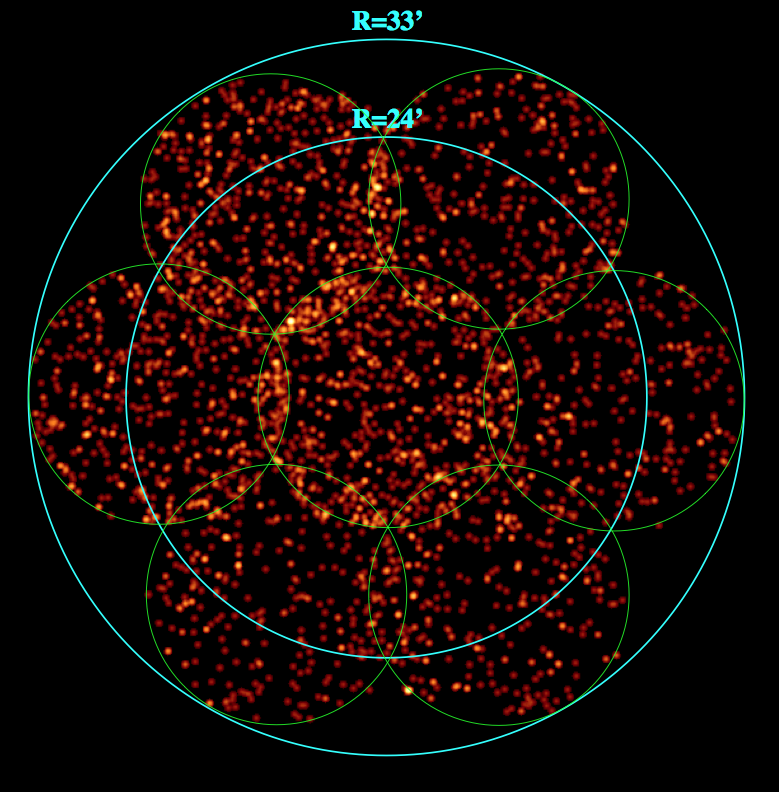
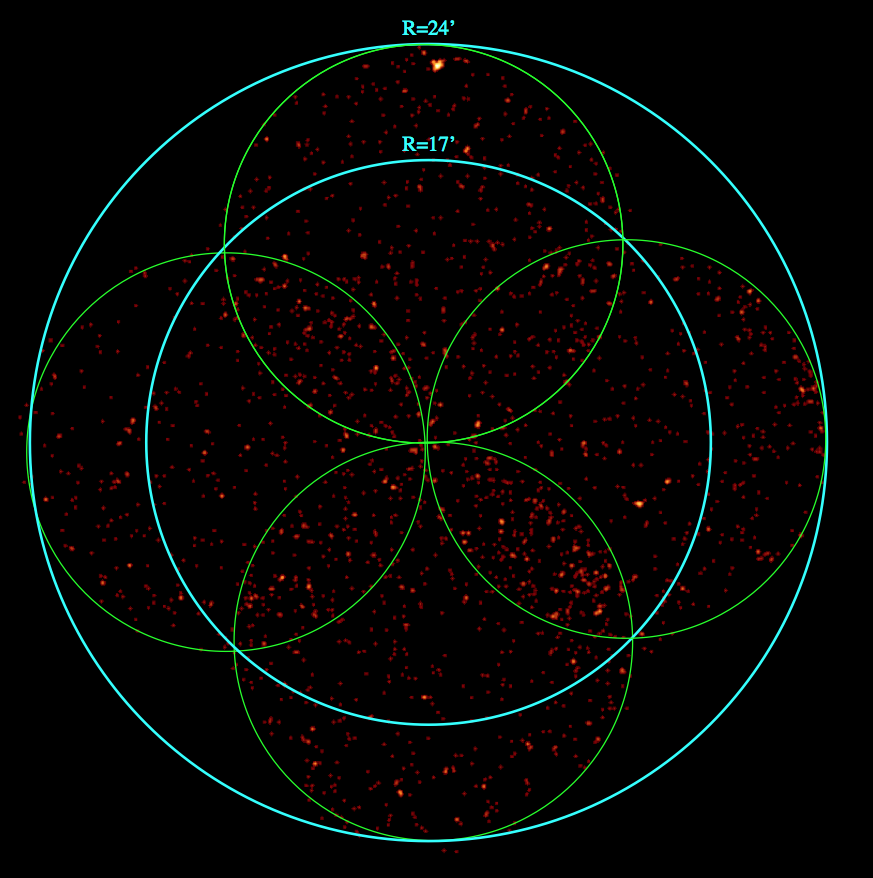
The default tiling configurations consist of four- and seven-tile patterns in a fixed arrangement. Coverage radii below should be compared to the approximately 11.8′ radius of the XRT field of view. Only the choice of pattern (4 or 7 tiles) and the center of the pattern may be specified — all other parameters are fixed and executed automatically on-board Swift.
These patterns offer the quickest way for Swift to observe targets with larger error circles. More complex tiling may be available through manual planning, but carries significantly higher overhead and longer lead times.
Four Tile Pattern
| 100% Coverage | 17′ radius |
| Maximal Coverage | 24′ radius |
Seven Tile Pattern
| 100% Coverage | 24′ radius |
| Maximal Coverage | 33′ radius |